Image - 2026-10-21 19:43
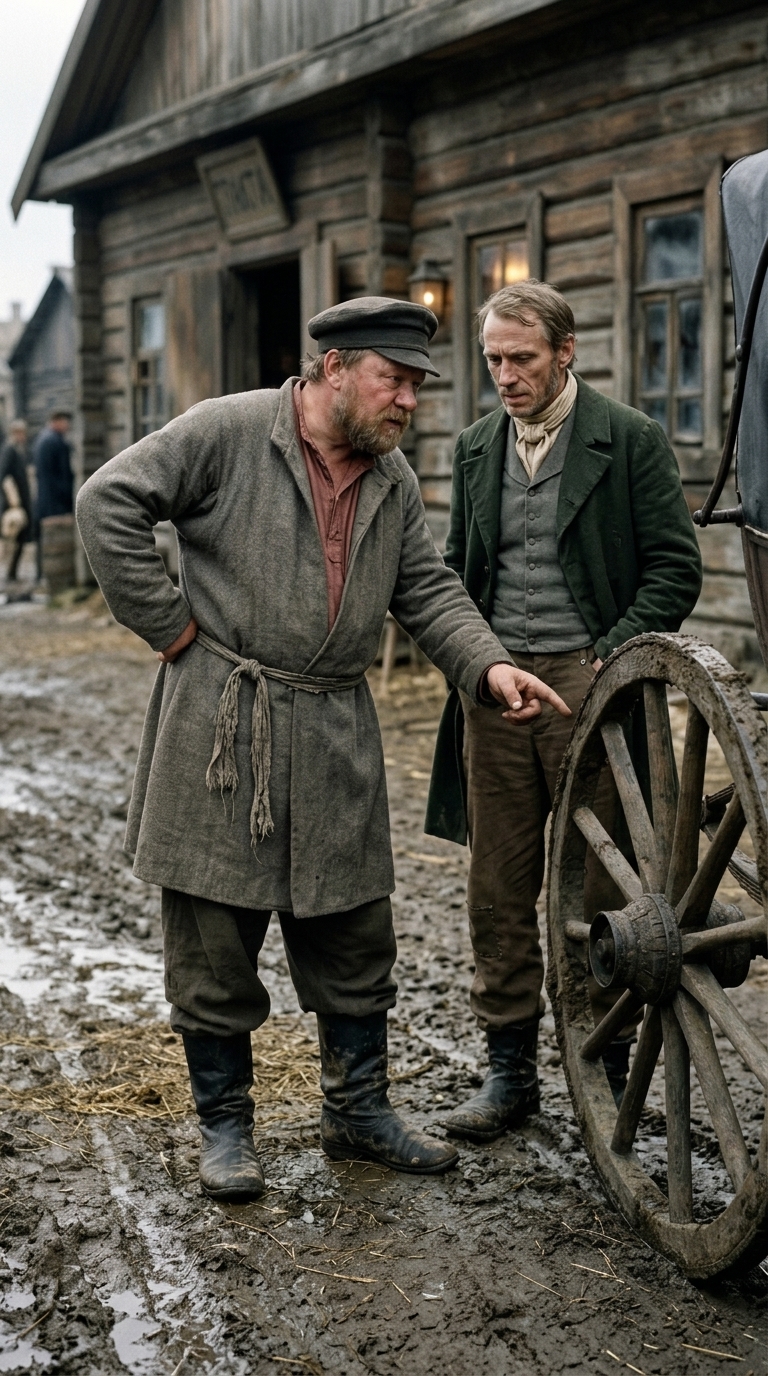
Art style: Историческая драма, реалистичная кинематографическая реконструкция России 1838–1842 годов. SCENE: Two ordinary Russian peasant men stand by the entrance of a modest provincial tavern opposite a hotel in early-1840s Russia. They have noticed a small horse-drawn britzka passing nearby and are casually discussing one of its wheels. CHARACTERS: Use PEASANT_1_MASTER and PEASANT_2_MASTER as visual references if available. Keep their faces, clothing, and body proportions consistent. They wear plain, coarse, period-appropriate garments, not festive folk costumes. One man is slightly turned toward the other and makes a small conversational gesture toward the carriage. The second man listens, looking toward the wheel. Expressions are natural and restrained. COMPOSITION: Vertical 9:16. Medium-wide composition showing both men from approximately the knees up, with a large wooden carriage wheel visible in the foreground or side of the frame. The wheel must belong to a historically plausible small travelling britzka. The tavern doorway is behind the men. The carriage is passing, not posed for a portrait. LIGHT AND COLOR: Warm amber lantern light softly illuminates the men's faces and the rim of the wheel. Dark chocolate-brown shadows, subdued earth tones, muted blue-grey fog in the background. Slightly damp cobblestones reflect a small amount of golden light. Atmospheric but readable faces. MOOD: A quiet, everyday exchange between local townsmen. No exaggerated comic expressions. The satire should come from the situation and source dialogue, not from caricature. HISTORICAL REALISM: Authentic early-19th-century Russian clothing, tavern entrance, carriage construction, natural human anatomy and realistic skin texture. NEGATIVE: No modern clothing, no embroidered festival costumes, no modern street signs, no cars, no theatrical posing, no comedy illustration, no distorted hands, no duplicate people, no text or watermark. ━━━━━━━━━━━━━━━━━━━━━━━━━━━━━━━━━━━━━━ FINAL STYLE ENFORCEMENT (this is the authoritative rendering directive — it overrides any style wording elsewhere in the prompt): Render this image entirely in "Историческая драма, реалистичная кинематографическая реконструкция России 1838–1842 годов" style. Match the lighting grammar, material response, colour science, level of realism / stylisation, line weight, and shading model typical of "Историческая драма, реалистичная кинематографическая реконструкция России 1838–1842 годов". Keep the subject, composition, camera angle, lighting direction, and colour palette from the description above — but EVERY surface, skin, fabric, material, and environmental element must be rendered in the "Историческая драма, реалистичная кинематографическая реконструкция России 1838–1842 годов" idiom, not in any other medium. Character appearance reference (MUST match exactly): - Первый прохожий: and centered — a Russian townsman of the early 1840s, a minor provincial passer-by. A man of about forty, medium height and stocky build, with a round weather-reddened face, small shrewd eyes, a bulbous nose and a short unkempt brown beard flecked with grey. He wears a long drab grey wool kaftan belted with a worn sash over a faded reddish-brown rubakha, loose dark trousers tucked into cracked black leather boots dusty from the road. A flat peaked cloth cap sits on his thinning hair. He leans forward slightly, one hand on his hip, the other scratching his beard, head tilted with open-mouthed curiosity as he examines a carriage wheel. Behind him stands the timber façade and low doorway of a provincial tavern, muddy unpaved street, overcast daylight. - Второй прохожий: centered on a muddy provincial Russian street of the early 1840s with low plastered houses and a wooden fence filling the sides. A second townsman, a lean man around forty, weathered pale skin, sharp cheekbones, light grey eyes with a reserved, slightly guarded expression as he answers his companion curtly. Thinning ash-brown hair combed back, short greying side-whiskers, clean-shaven chin. Modest build, slightly stooped. He wears a worn dark-green woolen frock coat buttoned over a grey waistcoat, a plain cream neckcloth, patched brown trousers, and scuffed black leather ankle boots caked with street mud. One hand tucked in his coat, head tilted as if mid-reply, overcast provincial daylight. - Селифан: beside a dusty travelling carriage in a provincial Russian inn yard, 1840s. Selifan, Chichikov's coachman: a broad, stocky Russian peasant man of about forty, weathered sun-reddened face, ruddy cheeks, small shrewd grey eyes, bushy light-brown beard and tousled hair under a low-crowned felt hat. Heavy build, thick shoulders, work-roughened hands. He wears a long coarse brown sheepskin-lined kaftan belted with a knotted red sash over a faded linen shirt, baggy wool trousers tucked into cracked tall leather boots caked with road mud. A coiled leather whip hangs from his belt; he holds a bridle strap, glancing sideways with a slow, half-drunk good-natured expression. Behind him, tired horses, harness, and grey overcast light. Reference images context (match the visual style and elements from these): - колесо брички (general): brand asset — use as visual context - бричка (general): brand asset — use as visual context - интерьер (general): brand asset — use as visual context
Бесплатный старт · Генерация видео и картинок с ИИ за секунды
More from this creator

More Gemini 3.1 Flash Image images
См. все →