Image - 2026-09-28 01:39
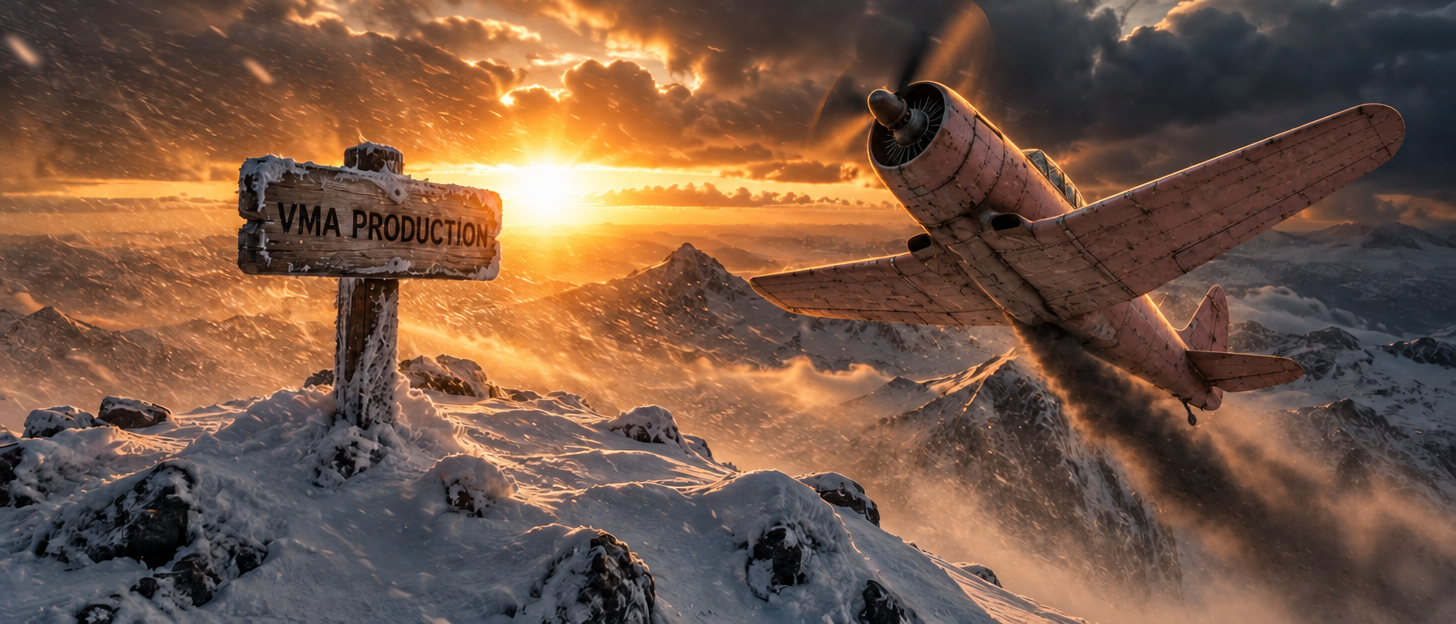
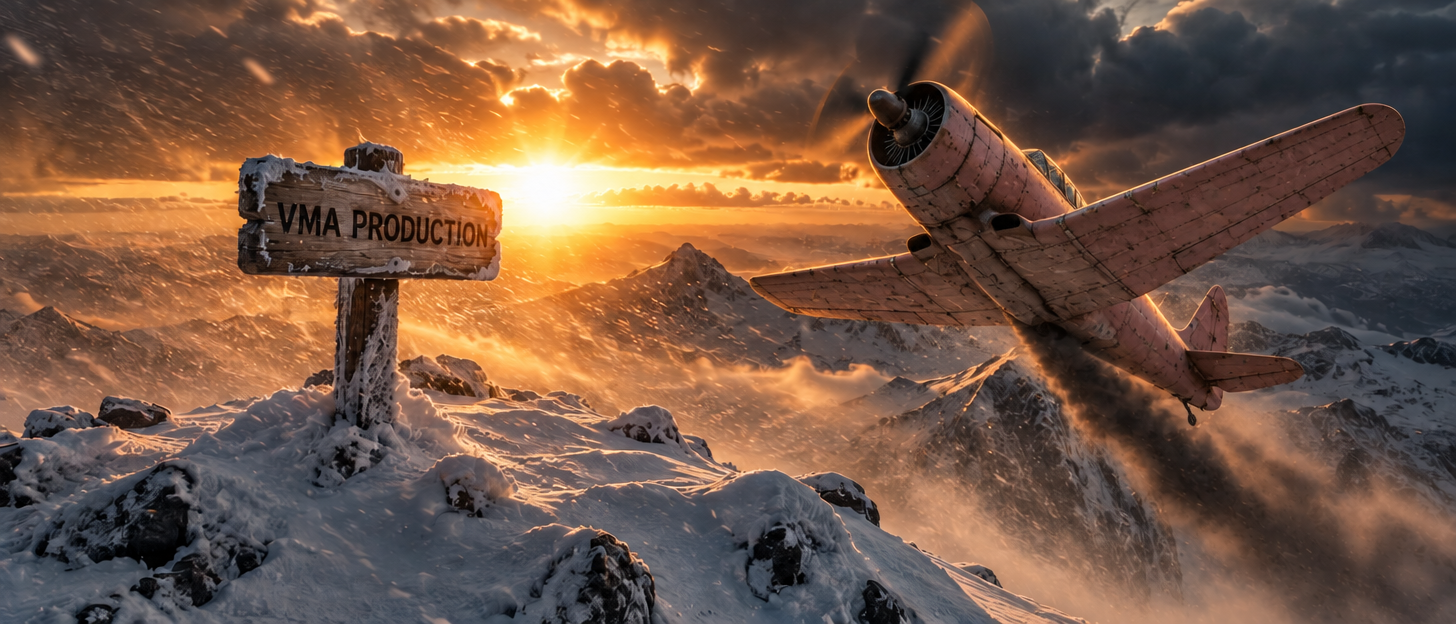
**STRICT IMAGE EDIT — PRESERVE THE ORIGINAL SCENE** Use the **FIRST ATTACHED IMAGE as the absolute master image**. The original image must remain unchanged. Add **ONE aircraft only**. Do not regenerate or reinterpret the existing landscape. Keep exactly the same: * 21:9 framing * camera position and perspective * foreground mountain * wooden sign and post * exact carved text **“VMA PRODUCTION”** * snow and rocks * mountain terrain * distant peaks * storm clouds * sunset * golden god rays * atmospheric haze * warm sunlight * shadows * exposure * color grade * overall composition **Nothing already present in the first image may be changed.** --- # THE AIRCRAFT — LARGE, EMERGING FROM BELOW THE MOUNTAIN Add the **PINK AIRCRAFT from the SECOND ATTACHED IMAGE**. The second image is used **ONLY as the aircraft appearance reference**. The aircraft appears in the **RIGHT SIDE of the frame**, very large and relatively close to the camera. ### CRITICAL SPATIAL ACTION The aircraft is **physically emerging from behind and below the mountain ridge on the right**. It is NOT simply flying across the sky. It has just cleared the mountain and is **bursting upward from underneath the ridge**, climbing aggressively into the open sky. At the moment captured by the camera, the aircraft is already rising rapidly, with its lower fuselage and underside prominently exposed toward the camera. The mountain ridge should feel like the aircraft has just emerged from behind it. **The aircraft must visually originate from the lower-right mountain area and rise upward into the right side of the sky.** Do not place the aircraft high above the mountain with empty space between the mountain and aircraft. Do not make it a distant airplane. Do not make it level with the horizon. --- # CAMERA / AIRCRAFT VIEW — EXTREMELY IMPORTANT The aircraft is seen from a **LOW THREE-QUARTER UNDERSIDE ANGLE**. The camera is positioned **below the aircraft**, looking upward at it. We see predominantly the **BELLY / UNDERSIDE** of the aircraft. The viewpoint is slightly offset toward the aircraft's side, so we simultaneously see: **UNDERSIDE + SIDE OF FUSELAGE** The underside is the dominant visible surface. Approximately: * **70% underside/belly view** * **30% side view** Clearly visible: * belly of the fuselage * underside of the left wing * underside of the right wing * lower engine cowling * lower fuselage structure * underside of tailplane * side flank of fuselage * side panel seams The aircraft should feel **very close, large and three-dimensional**, with strong foreshortening caused by the low viewpoint. --- # FLIGHT ATTITUDE The aircraft is in a **steep aggressive climb**. Nose clearly pitched upward. The longitudinal axis of the aircraft points strongly upward. Wings slightly banked. Dynamic three-quarter orientation. The aircraft is moving **upward and slightly leftward** from the mountain toward the open sky. The pose must communicate powerful acceleration and sudden emergence. No level flight. No hovering. No straight horizontal flight. No static aircraft. No frontal head-on view. No pure side profile. **The belly must remain clearly visible.** --- # AIRCRAFT APPEARANCE — REFERENCE 2 Reproduce the same physical aircraft from the second reference: * pale faded pink paint * heavily weathered metal * chipped paint * subtle rust streaks * realistic panel construction * authentic rivet rows * same fuselage proportions * same wing geometry * same tail configuration * same canopy * same round engine cowling * same propeller * same overall silhouette The aircraft should look like the **exact same real aircraft**, not a generic pink airplane. ### MAXIMUM UNDERSIDE DETAIL Because the camera is below the aircraft, the belly is highly visible. Render the underside with exceptional physical detail: * individual rivet rows * overlapping metal panels * panel seams * recessed access hatches * inspection panels * fasteners * small structural joints * subtle dents * chipped paint around panel edges * realistic corrosion and rust streaks * worn pink paint exposing darker metal underneath * mechanical attachment points * realistic underside surface curvature * authentic aircraft belly construction * small belly antenna where appropriate * visible structural elements around the wing roots * realistic junctions between fuselage and wings * detailed underside of the engine cowling * realistic tail underside All details must follow the **same aircraft construction shown in Reference 2**. Do not invent futuristic technology. Do not turn the aircraft into a military aircraft. Do not add weapons. Do not add external equipment that is not present in the reference. --- # ENGINE & PROPELLER The round piston-engine cowling is clearly visible from below. The propeller is spinning at high speed and appears as a **natural translucent motion-blurred disc**. The engine should feel mechanically real and physically connected to the aircraft. From the engine/cowling area, thick **dark oily piston-engine smoke** pours backward into the airflow. The smoke is turbulent and violently torn by the aircraft's movement. Because the aircraft is climbing, the smoke trail streams **behind and downward beneath the aircraft**, following the airflow rather than simply rising vertically. Dense black smoke close to the engine, gradually becoming more diffuse farther away. --- # NO AIRCRAFT MARKINGS The aircraft must be completely unmarked. **NO roundels. NO letters. NO numbers. NO symbols. NO insignia. NO logos. NO text.** Only weathered pale-pink painted metal. The only text allowed anywhere in the entire image is the existing: **VMA PRODUCTION** on the original wooden sign. --- # LIGHTING The aircraft must exist inside the **exact same sunset lighting as the first image**. Strong golden backlight from the existing sun. Warm rim light along the aircraft's upper edges. The underside remains naturally darker because the camera is looking upward at the aircraft against the bright sky. Subtle golden reflections on weathered pink metal. No new light source. No artificial glow. No studio lighting. No change to the original sunset. The aircraft must feel genuinely photographed in the same atmosphere as the mountain. --- # REAL PHOTOGRAPHIC INTEGRATION The aircraft must look like it was **actually photographed at this exact location**, not pasted into the image. Match: * atmospheric perspective * lens rendering * contrast * exposure * color temperature * natural motion blur * depth * atmospheric haze * sunlight direction * optical characteristics The aircraft is large enough to show fine mechanical and weathering details, while still maintaining believable distance from the camera. The 24mm lens produces a strong sense of spatial depth and dramatic perspective without unnatural distortion. --- # CAMERA LOOK Photorealistic cinematic 21:9 photograph. Real professional digital cinema camera. Large-format cinema sensor character. 24mm cinema prime. Wide environmental perspective. Strong spatial depth. Natural cinematic proportions. Wide dynamic range. Smooth highlight rolloff. Natural lens rendering. Natural color separation. Deep but detailed shadows. Refined micro-contrast. Restrained saturation. Subtle organic sensor texture. Physically realistic light response. No HDR. No oversharpening. No artificial clarity. No CGI. No 3D render. No game-engine look. No concept-art look. No matte-painting appearance. --- # FINAL COMPOSITION The **wooden “VMA PRODUCTION” sign remains exactly where it is in the original image and remains the primary focal point.** The **large pink aircraft is the second focal point**, occupying the right side of the frame. The aircraft is visibly **bursting upward from behind/below the right mountain ridge**, climbing hard into the sky. We see the aircraft **predominantly from underneath**, with a smaller but clearly visible portion of its side. The belly is highly detailed and sharply rendered. Its nose points upward. Its wings are slightly banked. Its propeller is spinning. Dark engine smoke streams backward and downward beneath it. The golden sunset illuminates the aircraft naturally. **The final image must look like one single real cinematic photograph captured at the exact moment the aircraft suddenly emerges from behind the snowy mountain.** **FIRST IMAGE = MASTER SCENE.** **SECOND IMAGE = AIRCRAFT APPEARANCE ONLY.** **ADD ONE AIRCRAFT. CHANGE NOTHING ELSE.**
Бесплатный старт · Генерация видео и картинок с ИИ за секунды
More from this creator


More Gpt Image 2.5 images
См. все →