Animate this Pushkin-style black-and-white pen-and-ink illustration showing the balalaika's trium...
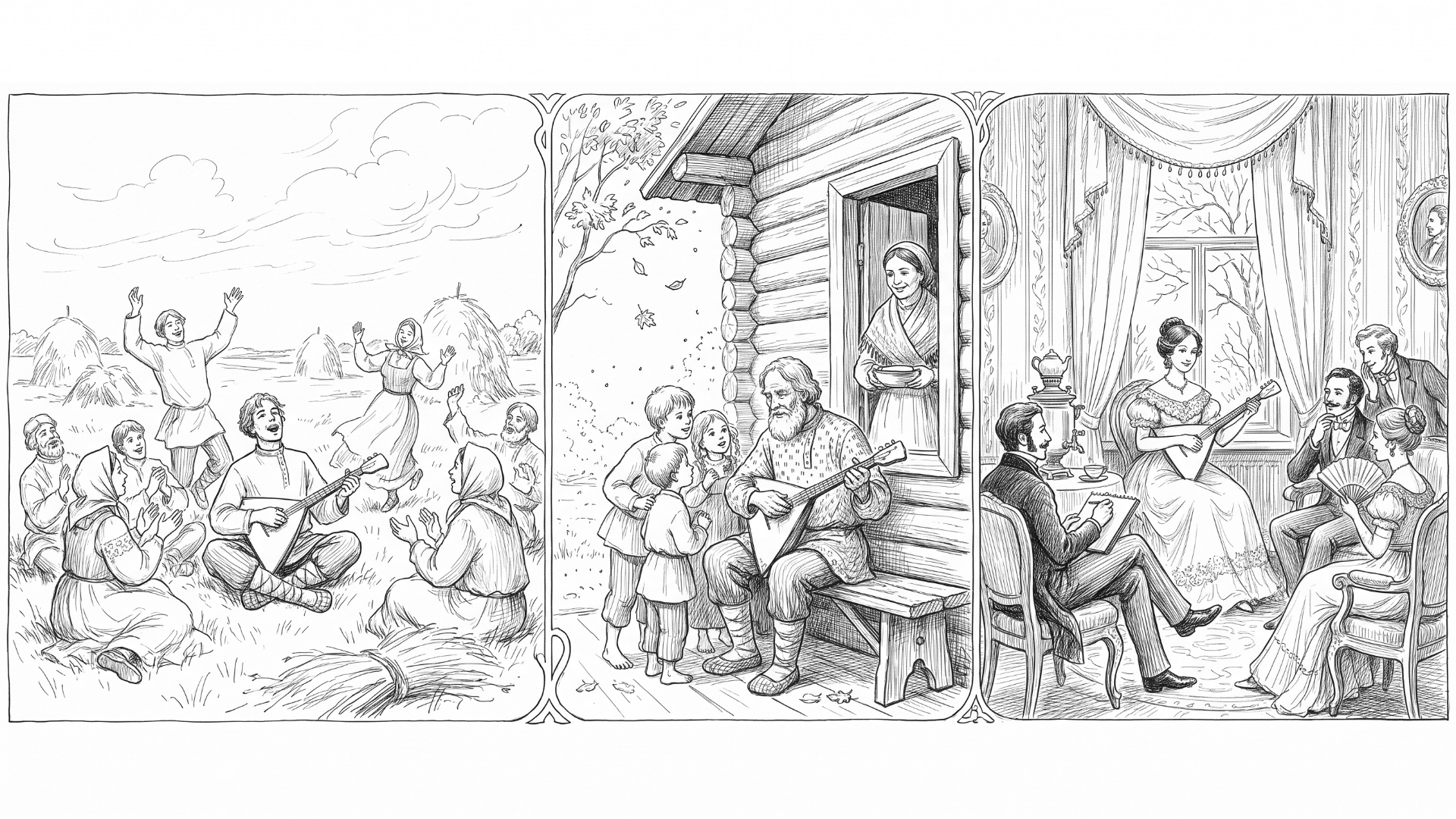
Animate this Pushkin-style black-and-white pen-and-ink illustration showing the balalaika's triumphant return to the Russian people. The scene is a triptych (three connected episodes) — in a field, on a village porch (zavalinka), and in an elegant drawing-room. The balalaika sounds everywhere — in every city and village. CRITICAL — NO ONE SPEAKS, NO ONE SINGS: No character speaks, sings, or opens their mouth. Everyone is silent — only the balalaika is heard. CRITICAL — INSTRUMENT ACCURACY: Every balalaika MUST have exactly THREE strings and THREE tuning pegs. Every balalaika must have the same shape and form as the reference image. Do not substitute any other instrument. STRICTLY BLACK AND WHITE: Pure black ink on white paper. No colors. No sepia. No grey tones. No tinting. Scene (three episodes): Episode 1 — In the field: A vast open field under a wide sky Peasants and workers gathered — a young man plays a balalaika (THREE strings, THREE pegs) Others listen, some dance, some work Haystacks in the background The mood is free, joyful, full of the open air Episode 2 — On the village porch (zavalinka): A rustic wooden house with a bench (zavalinka) by the entrance An elderly man sits on the bench, playing a balalaika (THREE strings, THREE pegs) Children gather around, listening A woman smiles from the doorway The mood is warm, intimate, timeless Episode 3 — In the drawing-room: An elegant 19th-century drawing-room with a piano, paintings, and soft lighting A young lady in an elegant dress sits by the window, playing a balalaika (THREE strings, THREE pegs) Gentlemen and ladies listen in refined silence The mood is cultured, warm, intimate Camera movement: The camera moves in a smooth arc (дуга) across the three episodes It begins in the field, slowly arcs to the village porch, then continues to the drawing-room The movement is continuous and fluid — a graceful, curved trajectory connecting all three scenes The camera pauses briefly on each balalaika, then continues The final shot: the camera settles on a wide view of all three episodes together, united by the balalaika Animation details: Episode 1 — Field: The young man's fingers move on the strings Others sway, dance, or listen No one speaks, no one sings The balalaika's melody carries across the field Episode 2 — Zavalinka: The elderly man plays gently Children sit still, listening The woman at the doorway smiles No one speaks, no one sings The balalaika's melody fills the quiet evening Episode 3 — Drawing-room: The young lady plays with grace Guests listen in refined silence No one speaks, no one sings The balalaika's melody fills the elegant room The balalaika: The unifying element — appears in all three scenes Every balalaika has THREE strings and THREE pegs The same shape and form as the reference AUDIO: The sound of a balalaika playing — a warm, folk melody NO speaking. NO singing. Only the music. The melody flows from one episode to the next, connecting them In the field — the music is open, free, expansive On the zavalinka — the music is intimate, warm, quiet In the drawing-room — the music is refined, elegant, gentle The melody continues throughout, unbroken A final, soft chord — the balalaika sounds everywhere Technical: 14-18 seconds duration Warm, unifying animation Camera movement: smooth arc (дуга) across all three episodes Preserve the original drawing style Include ambient audio as described Maintain the ultra-wide 2.39:1 aspect ratio STRICTLY BLACK AND WHITE — no colors NO ONE SPEAKS, NO ONE SINGS
Бесплатный старт · Генерация видео и картинок с ИИ за секунды